Getting Dressed for a Day with Two Different Settings
Getting dressed for a day with two different settings is easier when you plan the transition around each room’s dress expectations, activity, and available time.
How do you get dressed for a day with two different settings without carrying a second outfit? Treat the transition as its own dressing problem: decide what the first setting requires, what the second permits, and what can realistically change between them.
A client presentation followed by a gallery opening, for instance, may call for a different impression even if neither setting requires a full change. The useful distinction is not simply formal versus casual; it is what people will see, what you will be doing, and how much time and privacy you have to adjust.
Map the transition before choosing clothes
Write the settings in order and name the specific expectations for each. “Client presentation” might mean a jacket and a polished silhouette; “gallery opening” might mean standing, moving through a crowded room, and wanting one more expressive detail. These are more helpful notes than assigning either place a vague personality.
Then check the transition itself. Will you have a restroom or coat check, a place to set down a bag, and enough time to change an accessory? If the answer is no, plan a shift that can happen discreetly and quickly, or choose an outfit that needs no adjustment.
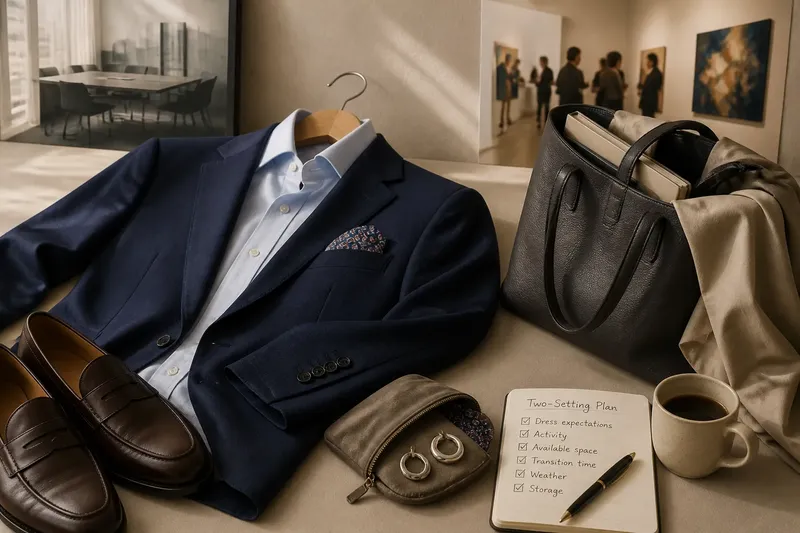
Imagine you have a morning presentation in a conference room and an evening opening at a nearby gallery. Your hypothetical starting point is a navy suit, a pale shirt, and loafers; you decide the suit works for both settings, but the presentation’s subdued styling feels too restrained for the opening. You pack a small pair of silver earrings and a patterned pocket square, then add the earrings and remove the pocket square after work. The expected result is a more personal evening look with no shoe change or bulky garment to carry.
Choose what should stay constant
Identify the pieces that can serve both settings, then judge them against the more demanding activity. A dress, shirt and trousers, or suit can anchor the day if it feels appropriate in both places and remains comfortable through the actual schedule. Check the fit while sitting, walking, and carrying what you need.
Make a separate decision about the visual message. A distinctive color, print, or shape can stay in place if it suits both rooms; if it reads too informal for the first setting, keep it for the later change instead. The point is to preserve the useful parts of the outfit, not to make every item neutral.
Before settling on the plan, look at the outfit as a whole in the mirror and consider how it will read in each setting. If the second place needs a substantially different silhouette or level of formality, an accessory may not bridge the gap. A short, practical clothing change can be more sensible than asking one outfit to make an implausible argument.
Plan one deliberate shift in tone
Choose one visible change that matches the difference between the settings. A pocket square, earrings, belt, lipstick, or scarf can add personality without changing the outfit’s basic structure. Pick based on the room and activity, not on a general rule that evening clothes must be more decorative.
Keep the change manageable in the place where it will happen. Earrings may suit a restroom stop; a belt may be awkward to change in a narrow stall; lipstick may be inconvenient if you will be eating immediately. If the item is delicate or difficult to store, choose another detail rather than giving it a day-long role as a loose object in your bag.
A second change is sometimes justified, but it should solve a real mismatch. If the first shoes are uncomfortable for the evening’s walking, for example, a practical shoe swap may matter more than adding another accessory. In that case, decide where the first pair will go before leaving home.
Use a short decision list for the day
Before you leave, check each part of the transition and let the result determine the plan. These checks are specific to a day with two settings, rather than a general wardrobe review.
- Dress expectations: If the same level of formality works in both places, keep the outfit’s main pieces; if not, add a suitable layer or plan a brief clothing change.
- Activity: If the day involves substantial walking or standing, choose shoes and fabrics that remain comfortable; if the first setting is seated and the second is active, plan a practical shoe change only if you can store the original pair.
- Available space: If you have a restroom, coat check, or secure place to set down a bag, use it for the planned adjustment; if not, choose a change that can be made discreetly without unpacking.
- Transition time: If there is enough time for the chosen change, pack that item where you can reach it; if the schedule is tight, wear the version that works in both settings.
- Weather between stops: If the route exposes you to cold or rain, carry a suitable outer layer; if you will move indoors without exposure, do not add a garment just to create a visual effect.
- Storage for removed items: If a layer or shoe has a secure place to go, include it in the plan; if it would need to be carried by hand, choose a different adjustment or leave it on.
Keep the packed change beside an ordinary item you will already carry, such as a work tote, rather than loose in a coat pocket. A small pouch can hold jewelry or lipstick; a folded pocket square can sit with a notebook. The useful test is whether you can find the item at the transition without emptying the bag onto a café table.
How should you handle the change between settings?
Should you change clothes between the two settings?
Change clothes when the activities or dress expectations genuinely conflict, not merely because the locations differ. If the main outfit works in both, a deliberate detail or layer adjustment can be enough; if it does not, a brief change is preferable to an uncomfortable compromise.
Which detail makes the clearest shift?
Choose the item that changes the impression without creating a new practical problem. Earrings or a scarf may add visual character, while shoes can matter more when walking or comfort is the issue.
What if there is almost no time to change?
Wear the version that works in both settings and skip any adjustment that needs privacy or careful handling. If one item can be added on the way, keep it somewhere reachable rather than at the bottom of your bag.
When is a layer better than an accessory?
A layer is the better choice when the transition involves temperature, coverage, or a meaningful change in formality. Choose one you can store sensibly once it comes off; if there is nowhere to put it, an accessory may be the more manageable shift.
Let the real constraint decide the plan
Two-setting days rarely follow the neat schedule imagined at home. A meeting may run late, a restaurant may be colder than expected, or the walk between places may take longer than planned. Keep the adjustment tied to a real need—comfort, dress expectations, or a more expressive finish—so it remains useful when the timetable changes.
For getting dressed for a day with two different settings, the best plan is the one that fits the actual transition, not an imagined costume change with a private dressing room and attentive luggage. Before leaving, make sure every item you plan to remove has somewhere to go; that small decision can matter more than the accessory itself.